What Is Structured Cabling?
Structured cabling is a standardized approach to wiring a building or campus so that all voice, data, video and other communications traffic shares a common infrastructure. It typically includes:
-
- Copper cabling (Category 5e, Category 6, Category 6A)
-
- Fiber-optic cabling (singlemode / multimode)
-
- Cable pathways, raceways, grounding & bonding systems
-
- Cable termination/patching, labeling, infrastructure documentation
-
- Testing and certification of the cable plant to standards (e.g., ANSI/TIA-568, EIA/TIA-606)
Orlando Business Telephone Systems describes exactly this kind of setup: “Category 6 Inside Cable, Single-mode and Multimode Fiber Optic Cable, Cable Testing and Certification Reports, Raceway Systems, Grounding and Bonding.”
The result of structured cabling is a network-ready infrastructure that is scalable, manageable and optimized for uptime and performance.
Why Structured Cabling Matters for Your Business
1. Performance & Reliability
When your network wiring is organized, terminated and certified properly, you avoid avoidable issues like crosstalk, attenuation and signal loss. For instance, structured cabling specialists note that “We test all structured cabling for cross-talk, cable length, impedance, attenuation and certify at project completion.”
2. Scalability & Flexibility
Modern buildings are not static—they face frequent changes: new access points, surveillance cameras, IoT sensors, growth of users, higher bandwidth demands. A structured system ensures you can add devices or expand without ripping out old wiring. Orlando Business Telephone Systems emphasizes that a properly designed network “supports application requirements today and future growth.”
3. Reduced Maintenance & Operational Costs
When the cable plant is labeled, documented and neatly installed, troubleshooting is faster and less disruptive. This means less downtime and lower total cost of ownership.
4. Future-proofing Your Infrastructure
With Category 6A copper and fiber optics, you’re ready for 10-Gbps and beyond, WiFi 6/7, large-scale surveillance, building automation, etc. According to an independent vendor: “A well designed structured cabling system … supports today’s demands and tomorrow’s growth.”
5. Unified Systems / One Network Architecture
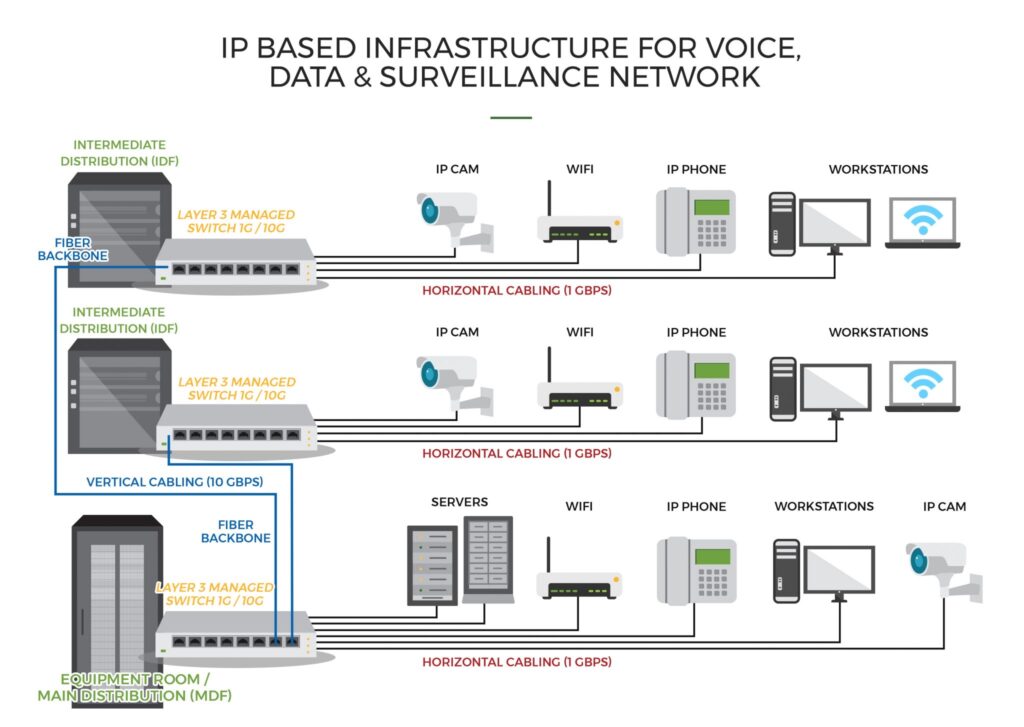
Orlando Business Telephone Systems takes this further: they promote a “One Network” architecture where voice, data, WiFi, access control, cameras, digital signage all run over the same structured backbone. They say:
“With One Network Infrastructure, your WiFi, security cameras, door access, and digital signage all communicate effortlessly.”
This reduces vendor sprawl, simplifies management and improves interoperability.