
Published October 26, 2026 · Orlando Business Telephone Systems
Cabling is rarely what makes an office move late. The carrier circuit is. A fiber or dedicated internet order placed six weeks before move day can still be sitting in engineering review when the trucks pull up, and there is no expedite fee that fixes it. Every other piece of a low-voltage relocation schedules backward from that one date.
The furniture plan gets four months. The network gets four weeks.
Most relocations we see across Orlando, Maitland, and Lake Mary follow the same shape. The lease gets signed, a space planner draws the floor plate, the mover is booked down to the hour, and somewhere around week ten somebody realizes the phones and the network have to work Monday morning. By then the two items with the longest lead times have already lost their runway.
Almost everything a cabling contractor does can be compressed under pressure. We can add crews, work nights, run a weekend. Carrier work does not respond to any of that. A circuit order enters a queue, gets engineered, sometimes gets handed to a construction group because there is no existing fiber path to your suite, and comes back with a date. You take the date.
Order dedicated fiber or DIA 60 to 90 days before move day. Treat anything shorter as a risk you are consciously accepting, with a backup plan attached. If the building has no fiber to your floor, the carrier may need to pull to the MPOE, coordinate riser access with property management, or permit outside work, and that adds weeks. Number porting for your business phone system runs on a separate clock: it needs a signed letter of authorization and a current bill where the account name and service address match exactly. One mismatch resets the port date.
Count backward from move day, not forward from today
This is the working timeline. Dates are relative to the day people sit down at desks, not the day the moving truck arrives, because those are frequently not the same day.
| Milestone | When | Who owns it | What breaks if you are late |
|---|---|---|---|
| Site survey, riser and pathway assessment | 90+ days out | Low-voltage contractor with landlord escort | You discover a full sleeve or a landlord-controlled shaft with no time to reroute or rebid |
| Building management approvals, COI, access rules | 90–120 days | Tenant and property manager | Crews get turned away at the freight elevator on day one of the pull |
| Carrier circuit order (fiber, DIA, SIP trunks) | 60–90 days | IT lead and carrier account team | Move day with no internet, plus the cost of a temporary wireless bridge |
| Number porting submitted | 60–90 days | Phone provider and tenant | Customers call a number that rings nowhere |
| Drop count and cable design finalized | 45–60 days | Contractor, IT, furniture vendor | Drops land where nobody sits, and every fix is a change order |
| Cable pull and rough-in | 30–45 days | Low-voltage contractor | You pay finished-space rates instead of pre-drywall rates |
| Telecom room: racks, panels, grounding, power | 14–30 days | Contractor and electrician | Nothing to terminate into; switches sit on the floor |
| Termination, testing, certification | 14–21 days | Contractor, RCDD oversight | No warranty, no baseline, and failures surface during week one |
| Cutover plan and parallel operation | Final 2 weeks | IT, carriers, phone provider | No rollback path when a circuit comes up dirty |
| Move weekend and day one coverage | Day 0 | Everyone, with named owners per system | Monday morning becomes the test |
Find out what the building will actually let you do
Central Florida office inventory leans heavily on multi-tenant buildings, and riser access is where moves quietly stall. Downtown Orlando towers, the Maitland Center corridor, the Lake Mary and Heathrow campuses, and the older Altamonte Springs and Winter Park stock all carry their own rules about who may open the shaft, during what hours, and under what insurance. Some buildings require their own vendor for anything inside the riser. That is a cost line and a schedule line, and you want it in writing at day 90. This is the first thing our structured cabling crews check on a relocation survey.
- 1 Pathway and riser realityWhere usable conduit exists, which sleeves are already full, and whether the shaft is landlord-controlled or open to your contractor.
- 2 MPOE and demarc locationWhere carriers actually terminate in the building and how far that is from your suite. Distance drives cost and sometimes drives which circuit types are even available to you.
- 3 Telecom room viabilityDedicated power, cooling, and a grounding path, or you are building a room. A storage closet with one shared circuit and no ventilation is not a telecom room, and finding that out at day 20 is expensive.
- 4 What the previous tenant leftCable in the ceiling, jacks in the walls, maybe a rack. Documented as an unknown inventory, not booked as an asset.
- 5 Access and insurance termsFreight elevator hours, certificate of insurance limits, after-hours escort fees, badge lead time. These decide whether a two-day pull becomes five nights.
The inherited cabling trap
Walking into a suite with cable already in the ceiling feels like found money. It usually is not. Abandoned cable arrives with three problems that cannot be resolved by looking at it: nobody can confirm the category, nobody has test results, and the manufacturer warranty is gone because it was registered to an installation nobody can now document.
A faceplate stamped Cat6 tells you what the faceplate is. It says nothing about what is behind the wall. We have opened enough ceilings to know that Cat6 outlets fed with Cat5e are common, mid-span splices happen, and staple damage from a long-ago build-out does not announce itself. Even where the cable is genuinely good, it was designed around somebody else’s furniture plan.
Test before you decide. Certifying existing runs costs a fraction of replacing them and returns a pass or fail on every link. Keep what passes and lands where you need it. Replace the rest.
Drop count follows the furniture plan, not the other way around
Drop locations are downstream of desk locations, so the cable design cannot be finalized before the furniture layout is approved. Contractors get asked to quote a drop count off a shell drawing constantly, and that number is almost always low. Wait for the approved plan, then walk it and add the things that never appear on a furniture drawing: wireless access points, ceiling cameras, door controllers, the conference room display, the copier alcove, the badge reader at the back entrance, the wall clock in the break room that turned out to be network-connected.
Add spare capacity while the ceiling is open. It is the last cheap moment you will get.
30–45 DaysPull cable before the walls close
This phase has a hard price attached to it. Pre-drywall installation currently runs roughly $100 to $150 per drop. Once the walls are closed and staff are working around you, the identical port climbs to $300 to $400, because the crew is working off ladders through a ceiling grid, fishing walls, moving furniture, and often working after hours to stay out of the way. On a 60-drop suite, that gap is $12,000 to $15,000 for nothing but timing. For a full per-category breakdown, see our guide to what structured cabling actually costs in Orlando.
| Line item | 2026 range | What moves the number |
|---|---|---|
| Cat6 drop | $125–400 each | Run length, ceiling access, whether the space is occupied |
| Cat6A drop | $175–500 each | Larger cable, tighter bend radius, heavier pathway fill |
| Pre-drywall vs. finished space | $100–150 vs. $300–400 | Timing only. Same cable, same jack, three times the labor |
| Telecom room buildout | $1,500–4,000 | Rack count, wall-mount vs. floor cabinet, patch panels, cable management |
| Testing and certification | About 5% of project | Link count. Unlocks the 20 to 25 year manufacturer warranty |
Build the room, then certify what you built
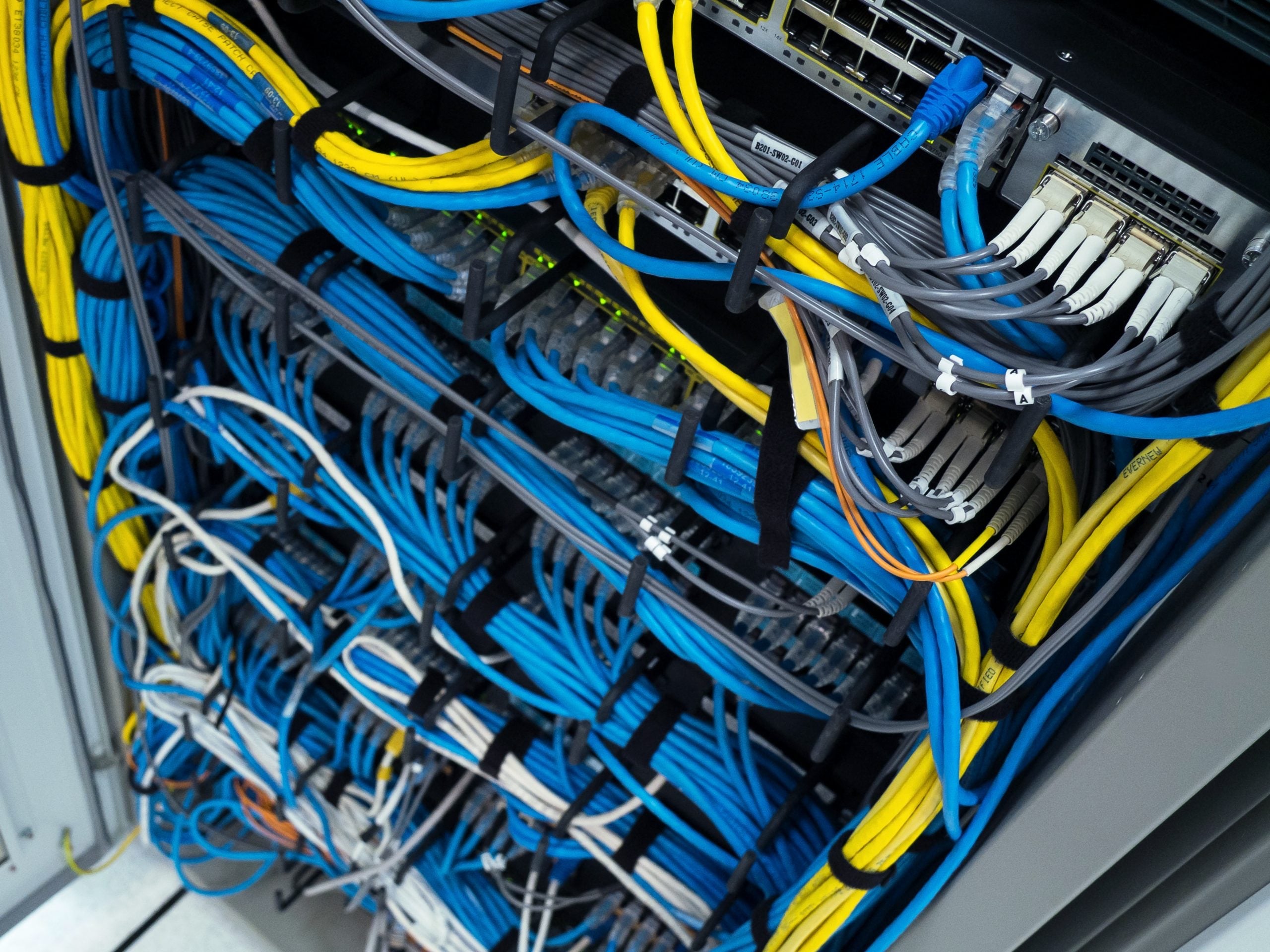
Racks, patch panels, cable management, and grounding are a separate scope from the drops and generally run $1,500 to $4,000 depending on rack count and whether a wall-mount will do. Sequence it before terminations rather than around them, and get the electrician’s dedicated circuits and the cooling sorted in the same window. This is part of the commercial network installation that gets switches off the floor and into a rack.
Then certify. Testing adds about 5% to the project and it is the cheapest 5% in the build. It produces a per-link test report you can hand to an auditor, an insurer, or the next tenant, and it registers the manufacturer warranty, typically 20 to 25 years on a properly installed and tested system. Uncertified cable carries no warranty and no baseline, which means every future intermittent fault gets diagnosed from scratch at an hourly rate.
Cut over in parallel, and keep the old circuits alive
Do not schedule disconnect at the old suite for move day. Overlap it. Two to four weeks of double billing on a circuit is trivial next to a Monday where nobody can take an order because the new fiber came up with errors or a port completed a day late. The old site is your rollback, and it only works if it is still connected.
Run the new site live before anyone depends on it. Circuits up and tested. Phones registered, with test calls placed from outside the building and to your published main number, not just extension to extension. Wireless verified against the built space rather than the predictive survey. Printers, payment terminals, alarm and elevator lines, and anything with a modem in it confirmed on the new network. Assign a named owner per system and write the rollback down.
Move weekend should be boring on the low-voltage side. If the cable is certified and the circuits have been live for two weeks, the weekend is mounting gear and patching. Day one is staffing the floor, because the failures that survive testing are always the odd ones: a legacy fax line, a scale in the warehouse, a door strike nobody documented.
Hurricane season changes the calendar
June through November shifts the math on any Central Florida move. Named storms pull carrier and utility crews onto restoration work, and a circuit install can slide with little warning. Building management may lock down roof and riser work while a storm is tracking, and permitting offices slow down after landfall. If your move lands between August and October in Kissimmee, Sanford, or anywhere along the I-4 corridor, two weeks of float is not padding. It is the plan.
- Carrier circuits are the critical path. Order fiber or DIA 60 to 90 days out; no expedite fee compresses a provisioning queue.
- Start number porting 60 to 90 days ahead, with the account name and service address matching the current bill exactly.
- Pulling cable pre-drywall runs $100 to $150 per drop versus $300 to $400 in finished, occupied space, roughly a third of the cost decided by timing alone.
- Do not trust inherited cable. Certify it before you reuse it.
- Keep the old circuits live two to four weeks past move day so you have a rollback.
- Add two weeks of float to any move scheduled during hurricane season.
Office relocation cabling FAQ
How far in advance should we start network cabling for an office move?
Start at 90 days or more before move day. The cabling install itself needs 30 to 45 days, but the site survey, landlord approvals, and carrier circuit orders that have to happen first are what set the schedule. Carrier provisioning is the long pole and should be ordered 60 to 90 days out.
Why do carrier circuits take so long to install?
A fiber or dedicated internet order is engineered before it is scheduled. If the carrier has no existing fiber path to your floor, the order moves to a construction group that may need to pull new fiber, coordinate riser access with building management, or permit outside work. That process runs on the carrier’s calendar and cannot be bought forward with an expedite fee.
Can we reuse the cabling the previous tenant left behind?
Sometimes, but never on assumption. Inherited cable has no test results, no verified category, and no live manufacturer warranty, and a jack stamped Cat6 does not guarantee Cat6 behind the wall. Certification testing the existing runs costs far less than replacing them and gives you a pass or fail on every link, so you keep what works and replace the rest.
How much does cabling a new office cost per drop?
In 2026, Cat6 drops generally run $125 to $400 each and Cat6A runs $175 to $500, driven mostly by run length and access. Timing matters more than category: a pre-drywall install runs roughly $100 to $150 per drop, and the same port ordered after move-in is a $300 to $400 line. Telecom room buildout with racks and patch panels is a separate $1,500 to $4,000.
Can we keep our phone numbers when we move offices?
Yes, in almost all cases, but porting has its own timeline and needs to start 60 to 90 days ahead. The losing carrier requires a signed letter of authorization and a current bill, and the service address and account name have to match exactly. One mismatch resets the port date, which is why porting is the item most likely to be late when it is left to the final two weeks.
Moving offices in Central Florida? Start with the survey.
OBTS has been designing and installing structured cabling and business phone systems across Orange, Seminole, and Osceola counties since 1982. If your move date is inside 120 days, the survey is the call to make this week.